
By High Desert Medium | Palm Springs Psychic Medium
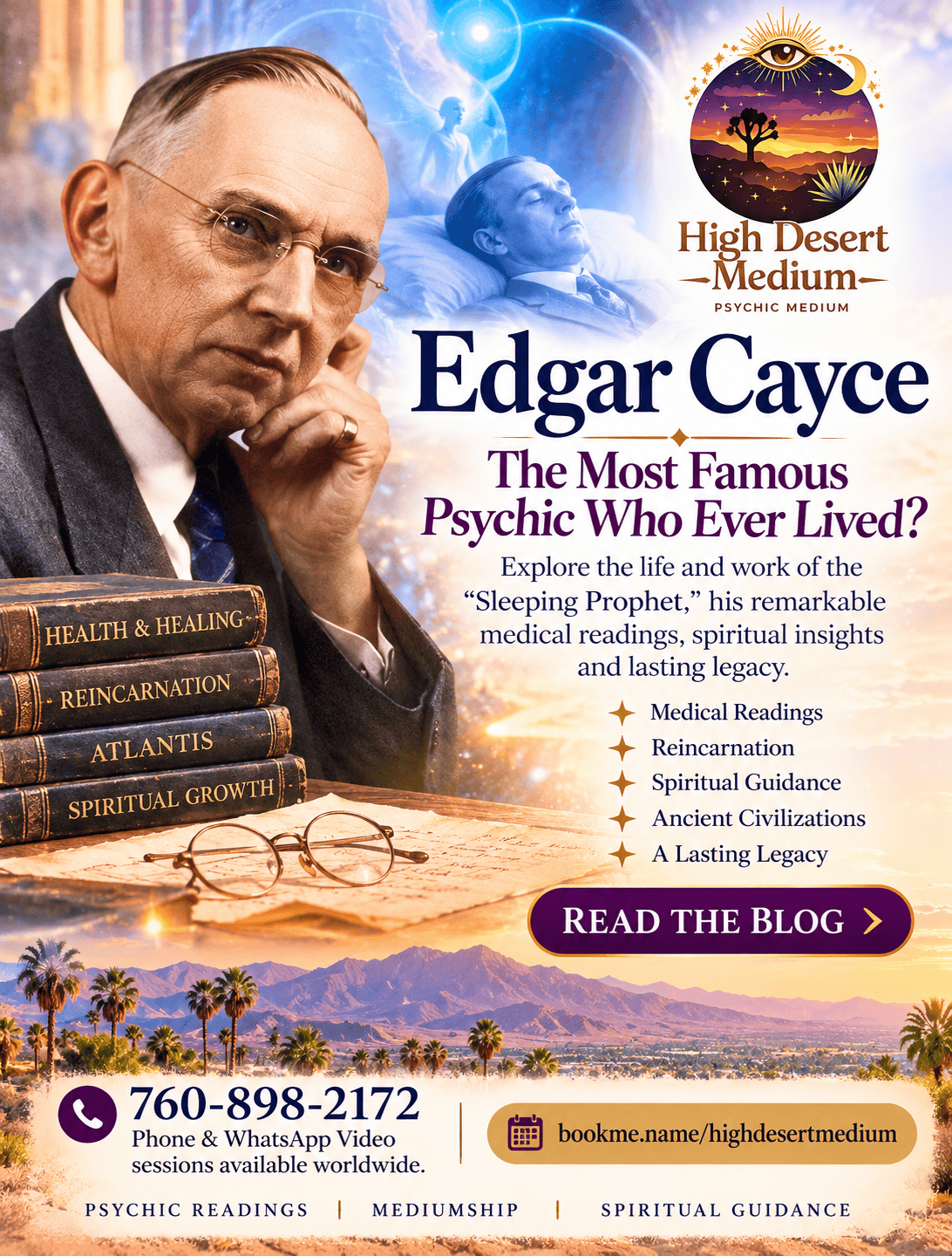
When people talk about famous psychics throughout history, one name almost always rises to the top: Edgar Cayce.
Known as the Sleeping Prophet, Cayce became one of the most remarkable and extensively documented psychics of the twentieth century.
What makes his story so fascinating isn’t simply that he claimed to possess psychic abilities.
It’s what he did with them.
Cayce became famous for entering a trance-like state and providing information about people’s health, sometimes offering detailed descriptions of physical conditions and recommending treatments.
He also explored reincarnation, past lives, dreams, spirituality, ancient civilizations and the nature of human consciousness.
But perhaps his greatest contribution was his desire to help people.
As someone who works with psychic ability and evidential mediumship, I find his story particularly interesting because it raises a question I’ve explored throughout my own spiritual journey:
How much information might consciousness be capable of accessing beyond our ordinary five senses?
Who Was Edgar Cayce?
Edgar Cayce was born on March 18, 1877, near Hopkinsville, Kentucky.
He grew up in a Christian household and developed a strong interest in spirituality and helping others.
According to biographical accounts maintained by the Association for Research and Enlightenment, Cayce reported unusual experiences beginning in childhood, including encounters with people he believed were in Spirit.
But his psychic abilities would eventually develop in a rather unexpected direction.
Cayce discovered that he could enter a sleep-like state and begin speaking about subjects he seemingly knew little about while awake.
During these sessions, he would lie down, close his eyes and enter a trance.
Someone would ask questions, and Cayce would respond.
Frequently, those questions involved people’s physical health.
Afterward, he often had little or no conscious recollection of what he’d said.
This unusual method eventually earned him the nickname the Sleeping Prophet.
The Remarkable Story of Cayce’s Lost Voice
One of the most frequently told stories about Cayce’s early development involves his own health.
As a young man, Cayce experienced a prolonged loss of his voice.
According to accounts of his life, conventional efforts to restore his speech had not resolved the problem.
During a hypnotic session, however, Cayce reportedly began speaking normally.
While in that state, he described what he believed was happening physically and suggested a way to address it.
His voice eventually returned.
The details of the episode have been told somewhat differently over the years, but it became an important turning point in his life.
Cayce began exploring whether this unusual state of consciousness might also provide information about other people’s health.
And that is where his story becomes truly fascinating.
A Psychic Who Helped People With Medical Problems
Imagine living in the early twentieth century.
Medical technology was nowhere near what we have today.
Diagnostic imaging was limited, antibiotics weren’t widely available, and many illnesses remained poorly understood.
Now imagine hearing about a man who could lie down, enter a trance and describe what might be happening inside another person’s body.
Sometimes that person wasn’t even in the same room.
In fact, some individuals seeking Cayce’s help lived hundreds of miles away.
According to accounts of his readings, Cayce would be given the person’s name and location.
He would then enter his trance state and begin describing their physical condition.
The readings sometimes included recommendations involving diet, circulation, digestion, spinal manipulation, exercise, massage, hydrotherapy and other approaches.
Many people who sought his help believed the information was useful, and some reported significant improvements.
Of course, these historical accounts don’t establish that Cayce could medically diagnose people through psychic means. But they do explain why he attracted so much attention.
He wasn’t simply predicting the future. He was attempting to use psychic information to improve people’s lives.
Cayce’s Approach to Healing Was Remarkably Holistic
Something I find particularly interesting about Cayce is that he didn’t view the human body as a collection of completely separate parts.
His readings frequently emphasized the relationship between physical health, emotional well-being, mental attitudes and spiritual development.
He believed that what happened in one area of our lives could influence another.
His recommendations often involved several approaches working together.
A person might receive suggestions concerning nutrition, physical treatment, rest, exercise and emotional attitudes.
Cayce also recognized the importance of working with healthcare practitioners.
This broader perspective eventually contributed to his reputation as a pioneer of holistic health.
Today, we’re accustomed to hearing discussions about the relationship between stress, emotional well-being and physical health.
During Cayce’s lifetime, his emphasis on considering the whole person was an important part of what made his work distinctive.
The Medical Readings: Real People, Real Records
One of the reasons Cayce remains so well known is the extraordinary documentation surrounding his work.
His organization preserves 14,306 recorded readings, covering subjects ranging from health and personal development to reincarnation and spiritual philosophy.
A substantial portion involved physical health.
And some of these records are surprisingly detailed.
For example, a woman identified in Cayce’s records as Subject 528 received a series of readings beginning in 1934.
Her documented sessions addressed skin problems and later more serious health concerns, including scleroderma.
The readings recommended various approaches involving diet, physical manipulation and other treatments.
Subsequent readings discussed her progress and suggested changes to her regimen.
The records include reports of improvement, although they don’t provide the kind of independently controlled medical evidence needed to establish treatment effectiveness.
What I find fascinating is the continuity.
This wasn’t simply someone receiving a vague prediction.
There were repeated sessions, specific recommendations and follow-up discussions.
Whether someone approaches these records as a believer, a skeptic or simply a curious observer, they provide an unusual window into the history of psychic healing.
The Hospital Edgar Cayce Helped Create
Cayce’s interest in helping people eventually went beyond providing readings.
He wanted somewhere people could actually receive the treatments recommended during their sessions.
In 1928, a hospital opened in Virginia Beach, Virginia, inspired by his work.
The facility was intended to bring together different approaches to health and healing.
Cayce envisioned a place where physicians and other practitioners could work cooperatively for the benefit of patients.
Unfortunately, financial difficulties during the Great Depression eventually brought the hospital’s operations to an end.
But the idea behind it didn’t disappear.
The building later became associated with the organization that continues preserving and sharing Cayce’s work.
I find this part of his story especially meaningful.
Cayce wasn’t content simply to provide information.
He wanted people to have an opportunity to use it.
More Than Medical Readings
Although his health readings initially brought him considerable attention, Cayce’s work eventually expanded into much broader spiritual territory.
He discussed reincarnation and the possibility that souls experience multiple lifetimes.
He explored dreams and their potential significance.
He spoke about ancient civilizations, including Atlantis.
He described spiritual growth as an ongoing process and emphasized the importance of personal responsibility, kindness and service.
He also discussed concepts resembling what many spiritual traditions describe as the Akashic Records—a spiritual record of experiences and knowledge.
Not every prediction or historical claim associated with Cayce has been verified, and some remain highly controversial.
But his work helped introduce generations of readers to ideas about consciousness that continue to be explored today.
What Did Cayce Believe He Was Accessing?
This may be my favorite question.
When Cayce entered his trance state, where did he believe the information came from?
Was he accessing a larger field of consciousness?
Was he connecting with a person’s soul?
Was he receiving information through some form of expanded psychic awareness?
Or was something entirely different happening?
Cayce’s teachings included the idea that consciousness could access information beyond the limitations of ordinary physical awareness.
That connects beautifully with subjects I’ve written about recently, including the soul, Higher Self and Oversoul.
What if our everyday consciousness represents only a small portion of what we’re capable of experiencing?
And what if certain states of awareness allow us to access information that normally remains outside our conscious perception?
I don’t pretend to know exactly what happened during Cayce’s readings.
But I find the possibilities fascinating.
Edgar Cayce and Modern Psychic Mediumship
Cayce’s work wasn’t identical to what I do as an evidential psychic medium.
My mediumship readings focus on communicating with loved ones in Spirit and providing recognizable information that helps identify the person coming through.
Psychic guidance involves accessing intuitive information that may help someone better understand their circumstances, relationships or possibilities.
Cayce’s readings often focused on physical health, spiritual development and what he believed were deeper levels of consciousness.
Different applications.
Different experiences.
But perhaps some of the same underlying questions.
Can consciousness access information beyond what we ordinarily perceive?
And if so, how might that information help us?
I think one of Cayce’s greatest contributions was demonstrating how seriously someone could dedicate their life to exploring those questions.
Was Edgar Cayce Really the Most Famous Psychic Ever?
Calling anyone the most famous psychic in history is subjective.
There have been remarkable psychics, mediums, mystics and spiritual teachers throughout the centuries.
But Cayce certainly has a strong claim to being among the most famous.
Consider what he left behind.
More than 14,000 documented readings.
An organization dedicated to preserving and studying his work.
A substantial body of books and educational material.
A historical connection to holistic healthcare.
And an influence that continues decades after his death in 1945.
His work has inspired generations of people interested in intuition, reincarnation, spiritual development and the possibilities of human consciousness.
Perhaps most importantly, his name remains recognizable even among people who have never received a psychic reading.
That’s quite a legacy.
What Can We Learn From Edgar Cayce Today?
For me, one of the most meaningful lessons from Cayce’s life is that psychic ability doesn’t have to be about predicting dramatic events or impressing people.
It can be about helping.
Offering insight.
Encouraging personal growth.
Helping someone understand themselves.
And sometimes simply providing comfort during a difficult period.
Cayce’s medical readings also remind us that curiosity and compassion can exist alongside responsible healthcare.
His historical recommendations should not be treated as substitutes for modern medical diagnosis or treatment, and many have never been adequately tested.
But his larger message about considering the whole person—body, mind and spirit—continues to resonate with people.
I also appreciate that Cayce’s story encourages us to remain open to possibilities.
Not every spiritual question has an easy answer.
Not every unusual experience fits neatly into our existing understanding.
And perhaps consciousness is far more expansive than we currently realize.
The Legacy of the Sleeping Prophet
Edgar Cayce died on January 3, 1945.
Yet more than eighty years later, people are still reading his work, studying his experiences and asking questions about the information he appeared to access.
That alone says something about the impact he made.
He helped bring conversations about psychic ability, reincarnation, spiritual growth and holistic health into the lives of thousands of people.
And he left behind something unusually valuable: an extensive written record that allows future generations to examine his work.
Whether you believe Cayce possessed extraordinary psychic abilities or simply find his story intriguing, there’s no denying his place in the history of modern spirituality.
He remains one of the most influential psychic figures of the twentieth century.
And perhaps the most interesting thing about his legacy isn’t what he claimed to know.
It’s how he tried to use that knowledge to help others.
Explore Your Own Connection With Spirit
Edgar Cayce’s life reminds us that psychic awareness and spiritual exploration can take many forms.
If you’re curious about your own intuitive abilities, looking for guidance in your life or hoping to connect with a loved one in Spirit, I offer private psychic and evidential mediumship readings through High Desert Medium.
I serve Palm Springs, Cathedral City, Palm Desert, Rancho Mirage, the Coachella Valley, Yucca Valley, Joshua Tree and the High Desert, with clients around the world.
Phone & WhatsApp Video sessions are available worldwide.
Call 760-898-2172 or book your private reading:
bookme.name/highdesertmedium
Edgar Cayce’s Life and Biography
Cayce’s Health and Wellness Readings
|History of the Edgar Cayce Hospital
Edgar Cayce’s Association for Research and Enlightenment