
By Dan Pickel | High Desert Medium | Palm Springs Psychic Medium
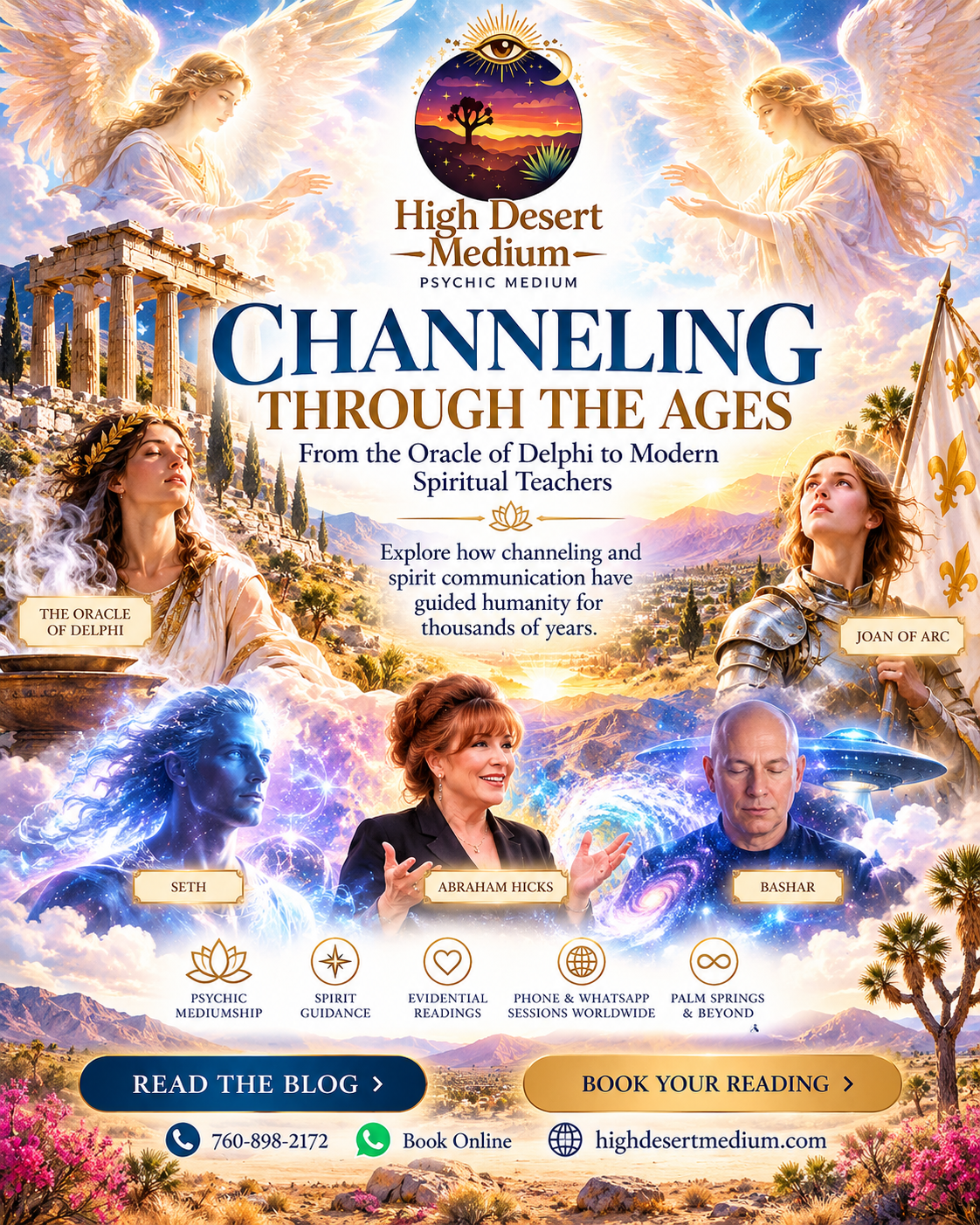
What if I told you that channeling, receiving messages from Spirit, and communicating with the unseen world are not new practices? In fact, people have been describing these experiences for thousands of years.
Long before we had terms like psychic medium, intuitive guidance, or spirit communication, people across the world were seeking answers from something greater than themselves.
From the Oracle of Delphi in ancient Greece to the biblical prophets, from Joan of Arc to modern-day psychic mediums, history is filled with accounts of individuals who believed they were receiving messages from beyond the physical world.
The names, religions, and methods may have changed, but the underlying experience has remained remarkably familiar.
As a psychic medium, I find that fascinating.
What Is Channeling?
Channeling is generally understood as the practice of receiving and communicating information believed to come from a spiritual or nonphysical source.
Depending on the tradition, that source might be described as Spirit, a deity, an angel, a guide, an ancestor, or a higher consciousness.
Some people experience channeling through words, while others describe receiving images, feelings, symbols, or an inner knowing that seems to arrive independently of their ordinary thought process.
There are different forms of channeling, and not all involve entering a trance or allowing another presence to speak through someone.
In my own work with psychic mediumship, communication often involves impressions and information that I must interpret and communicate to the person receiving the reading.
To me, the important part isn’t necessarily what we call the experience. It’s the information being received, how it is communicated, and whether it holds meaning for the person hearing it.
The Oracle of Delphi: Ancient Greece and the Voice of Apollo
One of the most famous examples of ancient channeling comes from the Temple of Apollo at Delphi, Greece.
For centuries, people traveled to Delphi seeking guidance about everything from personal decisions to matters of war and political leadership.
At the center of this sacred practice was a priestess known as the Pythia.
The ancient Greeks believed that the Pythia communicated the wisdom of Apollo, the god associated with prophecy, among other things.
She would deliver oracular responses that were sometimes interpreted and conveyed through the temple’s religious practices.
Kings, military leaders, and ordinary citizens sought her counsel.
Think about that for a moment.
Thousands of years ago, people were traveling great distances to receive spiritual guidance about their lives and futures.
Although the religious context was very different from modern mediumship, the desire to seek answers through a spiritual intermediary is something I recognize today.
People still want clarity. They still want reassurance. And they still want to know whether there is something greater than the physical world offering guidance.
Channeling and Divine Messages in the Bible
The Bible contains numerous accounts of people receiving visions, hearing divine messages, experiencing dreams, and communicating with angels.
Within biblical traditions, these experiences are generally understood as prophecy, revelation, or divine communication rather than channeling in the modern spiritualist sense.
Nevertheless, the similarities in how people describe receiving information are interesting.
Consider the prophet Samuel, who heard a voice calling his name before recognizing it as a message from God.
Or Daniel, whose experiences included symbolic dreams and visions requiring interpretation.
The prophet Ezekiel described extraordinary spiritual visions filled with imagery and symbolism.
In the New Testament, Mary receives a message from the angel Gabriel. Joseph is guided through dreams. And the Book of Acts describes visions, prophetic experiences, and spiritual gifts.
The Apostle Paul also discusses spiritual gifts, including prophecy and the discernment of spirits.
These accounts show how deeply experiences of spiritual communication are woven into religious history.
Of course, different faith traditions interpret these passages differently, and many distinguish sharply between divine revelation and mediumship.
My intention isn’t to suggest that every biblical prophet was a psychic medium. Rather, it’s to recognize that accounts of receiving messages beyond ordinary physical perception have been part of human spiritual experience for a very long time.
Joan of Arc: A Young Woman Guided by Voices
Perhaps one of history’s most compelling examples of claimed spiritual communication is Joan of Arc.
Born in France around 1412, Joan began reporting religious visions and voices during her teenage years.
She identified these experiences with Saint Michael, Saint Catherine, and Saint Margaret.
Joan believed the voices were guiding her toward a remarkable mission: helping France during the Hundred Years’ War.
Despite her youth and lack of military training, she became an influential figure in the French campaign that helped lift the siege of Orléans in 1429.
Her experiences also played a significant role in the religious trial that ultimately led to her execution in 1431.
Centuries later, the Catholic Church canonized Joan as a saint.
Historians, theologians, and medical scholars have offered different interpretations of her experiences. We cannot establish precisely what she perceived or where those experiences originated.
But what fascinates me is the conviction with which she described them.
Joan believed she was receiving guidance from a spiritual source, and those experiences profoundly shaped her life.
Whether viewed through the lens of faith, history, psychology, or spirituality, her story remains extraordinary.
Spiritualism and the Rise of Modern Mediumship
Although people had described communication with the spiritual world for centuries, the modern Spiritualist movement gained momentum during the nineteenth century.
In 1848, the Fox sisters of Hydesville, New York, became associated with reports of mysterious knocking sounds that were interpreted as communication from spirits.
Their story helped popularize séances, spirit communication, and mediumship throughout the United States and Europe.
The Fox sisters’ claims were controversial, and later admissions and conflicting accounts raised serious questions about their demonstrations.
Nevertheless, the movement that followed had a lasting cultural impact.
Mediums began holding public demonstrations, private sittings, and gatherings intended to explore the possibility of continued consciousness after physical death.
For many grieving families, the possibility of hearing from someone they loved brought hope and comfort.
That desire hasn’t disappeared.
Today, people still seek mediumship readings because they miss someone, have unanswered questions, or simply want reassurance that love and connection may continue beyond death.
Channeling, Psychic Abilities, and Mediumship: What’s the Difference?
Although these terms are sometimes used interchangeably, I think it’s helpful to understand the distinctions.
Channeling generally refers to receiving information believed to originate from a spiritual or nonphysical source. In some traditions, a person may enter an altered state of consciousness or communicate messages attributed to a guide or spiritual presence.
Psychic abilities involve intuitive impressions or information about people, situations, or possibilities. These experiences may be described through clairvoyance, clairaudience, clairsentience, or claircognizance.
Mediumship specifically focuses on communication believed to come from those who have passed from physical life.
In evidential mediumship, the intention is to communicate recognizable details about a loved one, such as personality traits, memories, relationships, or meaningful experiences.
That’s an important distinction in my work.
I’m not simply looking to offer broad spiritual statements. My intention is to communicate specific information that helps the person receiving the reading recognize the loved one being described.
And while I value the comfort that can come from a reading, I also believe people should be free to decide for themselves what an experience means.
Has Channeling Changed, or Have We Changed the Language?
This is something I find especially interesting.
Ancient Greeks spoke of oracles. Biblical writers described prophets and visions. Medieval Christians spoke of saints and divine voices. Nineteenth-century Spiritualists spoke of mediums and spirit communication.
Today, we hear terms like intuition, channeling, psychic development, and evidential mediumship.
Different traditions have their own beliefs, and I wouldn’t suggest that all these experiences are identical.
But I do see a recurring theme: people throughout history have described receiving information or guidance that they believed came from beyond their ordinary senses.
Perhaps what has changed most is the language we use to describe these experiences.
And perhaps our willingness to talk about them openly has changed as well.
Can Anyone Learn to Channel or Develop Their Intuition?
I believe intuitive awareness is something many of us can explore and develop.
You may already have experienced moments when you knew something without understanding how you knew it.
Perhaps you’ve had a dream that felt unusually meaningful, sensed the presence of someone you loved, or received an impression that seemed to arrive out of nowhere.
Not every unusual feeling or coincidence needs to be interpreted as spiritual communication.
But I believe there’s value in paying attention to our inner experiences rather than immediately dismissing them.
For someone interested in developing their intuition, I often suggest starting simply.
Spend a little time each day in quiet reflection. Notice the impressions that arise. Keep a journal of dreams, symbols, and intuitive experiences. Practice distinguishing a calm impression from a thought driven by fear or expectation.
And most importantly, be patient with yourself.
Developing intuitive awareness isn’t necessarily about dramatic visions or hearing voices. Sometimes the quietest impressions are the ones worth exploring.
If you’re interested in developing your own psychic or mediumship abilities, you’re also welcome to reach out to me.
An Ancient Practice With a Modern Purpose
When I look at the history of channeling, what stands out to me isn’t simply how old these traditions are.
It’s how deeply human the desire for spiritual connection has always been.
People want answers. They want to understand their purpose. They want guidance during difficult times.
And when someone they love passes away, they want to know whether that connection has truly ended.
As a psychic medium, I believe our relationships with those we love can continue beyond physical death.
That’s part of what makes my work so meaningful to me.
Whether we’re discussing an ancient oracle, a biblical vision, Joan of Arc, or a modern mediumship reading, we’re exploring one of humanity’s oldest questions:
Is there more to our existence than the physical world we see around us?
It’s a question people have been asking for thousands of years.
And I suspect we’ll continue asking it for thousands more.
Experience a Psychic Mediumship Reading With High Desert Medium
If you’re curious about spirit communication, looking for guidance, or hoping to connect with a loved one who has passed, I invite you to schedule a private session with me.
At High Desert Medium, I offer evidential psychic mediumship readings and psychic guidance with compassion, honesty, and care.
Based in Cathedral City, I serve Palm Springs, Palm Desert, Rancho Mirage, La Quinta, Indio, Joshua Tree, and the greater Coachella Valley, as well as clients worldwide.
Phone and WhatsApp Video sessions are available worldwide.
Call or WhatsApp: 760-898-2172
Book your private reading: https://highdesertmedium.com/
Love doesn’t end when life does.